
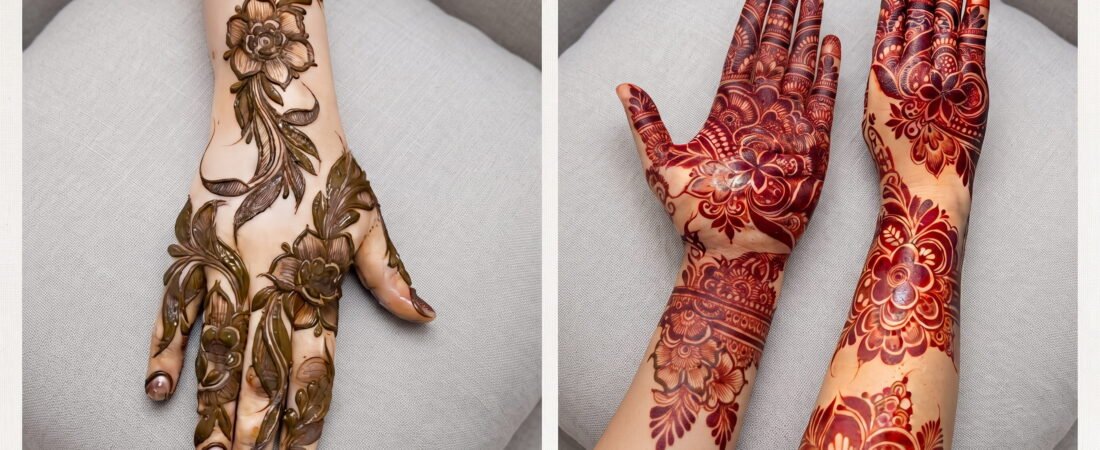
Bridal henna in Oman has always meant full coverage: hands, forearms, feet and calves, worked in dense Khaleeji floral or fine Indian detail over five or six hours. That is still the tradition, and it is still beautiful. But a growing number of brides in Muscat are asking for something quieter.
Minimalist bridal henna keeps the meaning and the ceremony, and trades the density for negative space. Fewer motifs, more skin showing, cleaner lines. Done well it photographs better than heavy work, sits comfortably with a modern dress, and takes a fraction of the time.
What counts as minimalist henna?
It is not simply “less henna”. A minimalist design is planned around the empty space rather than filling it. The artist places two or three anchor points on the hand and lets the skin between them carry the design.
- Fine linework instead of thick, filled blocks
- Open palms, with the pattern running along the fingers, wrist or back of the hand
- One focal motif rather than a repeated all-over pattern
- Clean edges with no shading, dotting or heavy fill
- Symmetry across both hands, so the look still reads as bridal
Five minimalist styles Omani brides are booking
1. The finger-tip and knuckle design
Thin bands across the knuckles and fine detail on the fingertips, with the palm and back of the hand left bare. It sits well under rings and shows clearly in ring-shot photography.
2. The single vine
One continuous vine from the wrist to the middle finger, usually with three or four small leaves or buds. It is the most requested minimalist design for engagement parties and Milcha ceremonies.
3. The bracelet band
A patterned cuff around the wrist, two to four centimetres wide, with nothing above or below it. Traditional Omani motifs work well here because the band gives them a frame.
4. Negative-space Khaleeji
The familiar Gulf floral vocabulary, drawn in outline only and spaced out so the skin shows through. It keeps the regional identity without the weight, which makes it the usual compromise when the bride wants minimal and the family expects traditional.
5. Fine geometric
Straight lines, small triangles and dot clusters running along one side of the hand. It suits brides wearing a plain, structured dress and reads well against gold jewellery.
What minimalist henna gets you
Time. A full bridal set is five to seven hours of sitting. A minimalist set is 45 to 90 minutes for both hands. If your henna night runs alongside family visits, that difference matters.
Cleaner photographs. Dense work turns into a dark mass in photos taken under warm indoor lighting. Open designs keep their detail.
An easier fade. A light design fades to a soft, even shadow. Heavy work fades unevenly and can look patchy after ten days, which is worth thinking about if you travel straight after the wedding. If you need it gone faster, read our guide on fading henna safely.
Fewer stain problems. Thin lines dry evenly and are less likely to smudge while you move around during the night.
Where minimalist henna is the wrong choice
Be honest about the setting. If your henna night is a large traditional gathering and the older women in your family expect to see full bridal coverage, a bare-palm design will be read as unfinished. Two things usually solve this: keep the hands minimal and add a fuller traditional design on the feet, where it stays private but present; or use the negative-space Khaleeji style, which satisfies both readings.
Also consider your dress. Long fitted sleeves hide forearm work entirely, so putting the design on the hands and fingers is the practical call, not just the fashionable one.
Getting the darkest stain on a light design
Thin lines have less paste in contact with the skin, so aftercare matters more, not less. Leave the paste on for a minimum of six hours, eight if you can manage it. Scrape it off, do not wash it. Keep water off the area for the first 24 hours while the stain oxidises from orange to deep brown. Full detail is in our guides on preparing your skin and darkening the stain naturally.
One rule that is not optional: insist on natural, organic paste. Salon “black henna” contains PPD, which burns and scars, and it is more common in light designs because clients want instant dark colour from a thin line. Read why black henna is dangerous before you book anywhere.
When to book
Apply your bridal henna two days before the wedding. The stain reaches its darkest point roughly 48 hours after the paste comes off, so same-day or next-day application means you photograph an orange stain rather than a deep maroon one.
For a minimalist set, book at least three weeks ahead during wedding season and Eid, when the calendar fills fast.
Book minimalist bridal henna in Muscat
We work with 100% natural, organic henna paste, mixed fresh for every appointment, and we design around your dress, your jewellery and the setting of your night. Home appointments across Muscat. See bridal henna in Muscat for packages and timing, or browse the portfolio for recent work.